



 Online courses
 Lessons
 Pad
Pad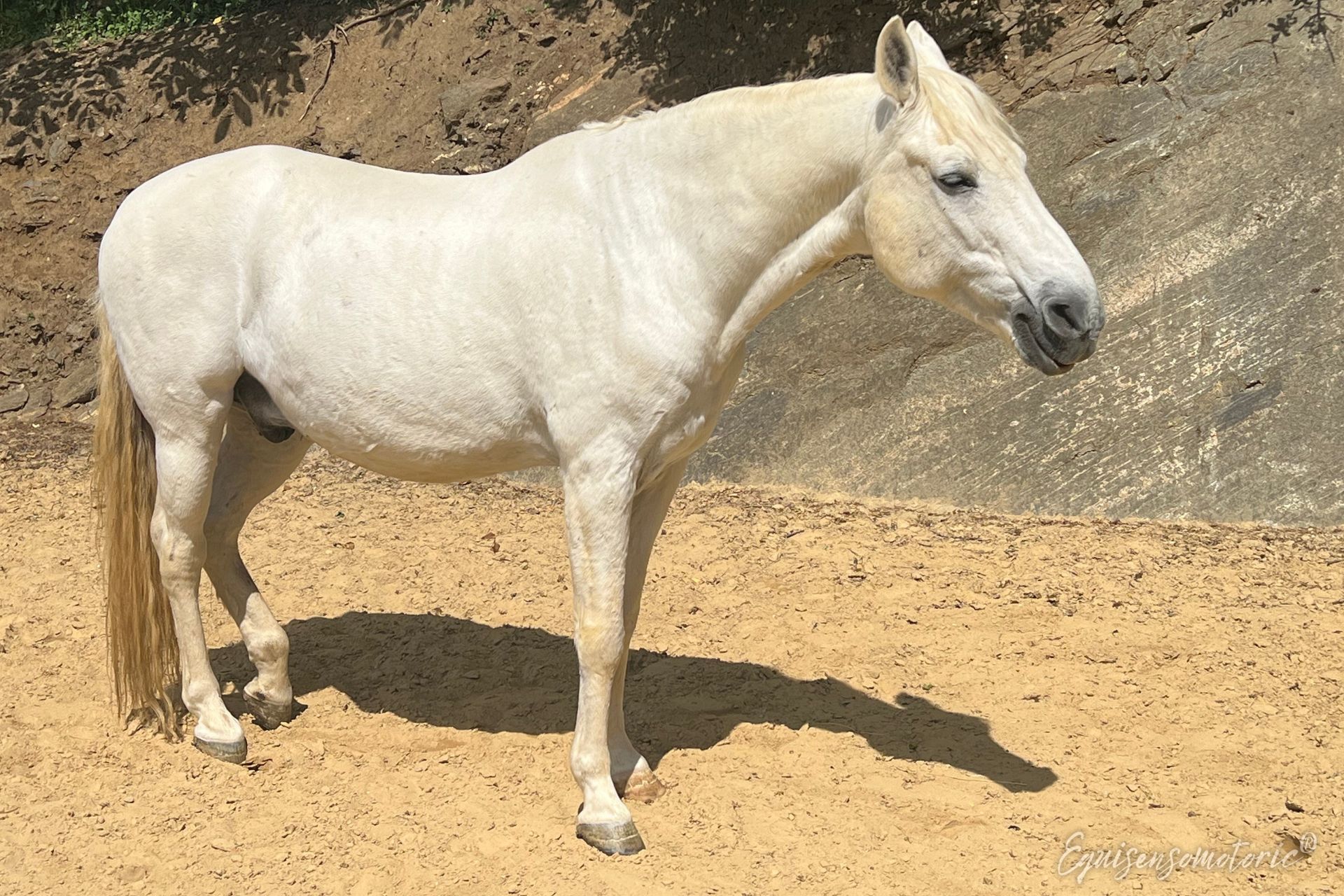
Already 27 years old
and thanks to Equisensomotoric training, timed hay feeder, mineral supplementation, and hay and alfalfa pellets, this horse is in an excellent muscle condition
Optimal nutrition is essential for hoof growth and muscle development. Here are my five most important feeding tips for successful muscle building!
Less is often more
The advertising promises and photos of muscular horses on feed labels are often very tempting. However, for muscle and back muscle development, it’s not necessary to buy as many expensive “muscle-building” supplements as possible. On the contrary: less is often more. In most cases, the best possible hay (fed in many small portions) and a high-quality, balanced mineral mix are perfectly sufficient to sustainably support both the back muscles and the overall physical development of your horse. The more individual feeds are fed, the higher the burden of additives and the risk of allergens and unwanted contaminants. Many products overlap in their composition or contain ingredients that can hinder each other’s absorption. A reduced, well-planned feeding regimen is therefore usually much healthier and more effective in the long run than a ration overloaded with individual products.
There’s no way around high-quality hay
Hay should be the foundation of every horse’s diet. Naturally, it should be mold-free and of the best possible quality. Skimping on this can be very expensive in the long run and harm the horse. Mold spores in hay often lead to respiratory problems, reduced performance, or, in the worst case, even render the horse unrideable. Therefore, it makes sense (and is ultimately cheaper) to get a few spare bales if the hay is of poor quality.
Hay molds due to improper storage (too tightly packed haystacks allow the hay to mold) or if it is exposed to rain during or after drying. Unfortunately, in some years, it rains heavily across the region during the hay harvest, making it very difficult to produce good quality hay. Soaking the hay in water for 10 minutes, or even better, steaming it, can help to prevent damage. If necessary, hay pellets can provide a temporary solution. However, it is usually more economical to have hay delivered from a region that has simply had good weather. Mold contamination can be detected in advance with a simple laboratory analysis, thus preventing chronic long-term consequences and high veterinary costs. All you need to do is send a handful of hay to the lab.
You can also have the protein and sugar content determined at the same time in the lab. Sugar content is an important factor in cases of obesity and laminitis (sensitive hooves are often an undetected, mild form of laminitis). Consider this: If your hay has, for example, a 10% sugar content and your horse eats 10 kg of hay in 24 hours, that adds up to 1 kg (!) of pure sugar per day! That’s an enormous amount and, logically, makes many horses overweight and ill. Very few horses can tolerate ad libitum hay feeding without becoming ill in the long run (the prairie is sparse, and horses are biologically adapted to this), and hay must absolutely be rationed. Every additional kilogram of hay beyond your horse’s maintenance requirement (the amount of hay at which your horse neither gains nor loses weight) requires one hour of brisk walking to burn off the excess energy. For example, if your horse’s maintenance requirement is 7 kg, but it eats 10 kg, it would need to walk briskly for three hours daily to burn off this excess or it will store this energy in build fatty deposits.
Excess weight is very harmful to horses as ist causes laminitis and it also leads to fatty deposits in the lungs and heart. Therefore, if the amount of hay needs to be reduced, which may be necessary due to high sugar content or because your horse is genetically prone to being overweight, special attention is required. In this case, it must be ensured that the horse still receives sufficient protein for muscle development and hoof growth through its daily ration. Protein deficiency often develops gradually and can significantly hinder training progress.
If you are unsure, it is advisable to seek scientifically sound nutritional advice and have a ration calculation prepared. Protein can be supplemented as needed, for example, in the form of oilseeds. As a personal guideline: I feed first-cut hay, harvested late, which means it has a relatively low protein content. If I reduce my 450-kilogram horse’s hay intake to less than 9 kilograms within 24 hours, in my case the protein supply is no longer sufficient. These figures can vary depending on hay quality and horse type, but they illustrate the importance of individualizing feeding and keeping an eye on protein.
High Fiber Content and Short Feeding Intervals
Horses whose hay intake is reduced should, in addition to short feeding intervals and possibly protein supplements, also receive roughage. Roughage increases chewing frequency (chewing produces alkaline saliva, which helps prevent stomach ulcers) and promotes satiety! An overweight horse will become ill. A horse that is constantly hungry will also become ill. Roughage can be offered in the form of straw or branches, which increases the feeling of fullness. The first cutting (especially late in the year) has a high roughage content, while the second cutting has a much lower roughage content. Feeding second-cut hay therefore leads to a shorter feeling of satiety in the horse. Up to one-third of the daily hay ration can be replaced with mixed-in straw to increase the roughage content. Straw should not exceed one-third, as this can lead to impaction colic.
So horses buffer their constantly produced stomach acid with their saliva. But this saliva is only produced when they chew. If feeding intervals frequently exceed five hours, the stomach acid can severely damage the horse’s stomach, leading to ulcers and gastritis. This is an evolutionary adaptation, as horses are “made” to constantly graze small amounts of grass in their often sparse natural environment. In captivity, we must mimic this as closely as possible. Timed hay feeders are a quickly recouped investment (in terms of long-term equine health), since none of us wants to get up at 3 a.m. to bring the horse a small amount of hay. Especially in stall confinement, it’s evident that by midnight at the latest, everything is usually eaten up. If the next portion of hay arrives at 6 a.m., six hours have already passed (without the crucial alkaline saliva that buffers the stomach acid). Mixing with straw or installing a hay box that opens automatically during the night can quickly remedy this situation.
Mineralization is necessary
In addition to high-quality hay, I generally recommend administering a good mineral supplement. I studied animal nutrition as part of my university degree and encountered numerous objective, scientific studies. These clearly demonstrate the significant decline in biodiversity on our hay meadows over the past 50 years. Mineral-rich herbs, in particular, are much less common in meadows today than they used to be, as many meadows, due to the intensification of agriculture and grass reseeding primarily tailored to the needs of dairy cows, now contain only a few plant species. For this reason, a balanced mineral supplement, rather than feeding individual minerals, is advisable, in consultation with veterinarians. It is important to pay attention to the form of the minerals contained.
Simply read the fine print on the back of the mineral supplement package. Easily absorbed organic compounds are often identified by the ending “-ate,” for example, -chelate, -citrate, or -fumarate. Inorganically bound nutrients, which often end in “-it” or “-id,” are largely excreted unused and therefore offer little benefit to the horse. Magnesium, for example, is an important macronutrient for cell communication. If magnesium is inorganically bound, i.e., fed as magnesium oxide, then its bioavailability (i.e., how well the body can absorb the nutrient) is unfortunately rather poor. If magnesium is organically bound and fed as magnesium fumarate, the body can absorb the nutrient much better. While the production of organically bound nutrients is more expensive for the manufacturer (and therefore the product is also more expensive for you), your horse benefits from it.
If you want to do it properly, you should have your hay analyzed for its nutrient content and buy a mineral supplement that compensates for any deficiencies in the hay. However, this only makes sense if your hay comes from a specific environment (i.e., from a farmer or from relatively uniformly vegetated meadows). If you or your stable owners have to buy hay from different locations and from far away, sending it to a lab is less useful. This is because nutrient levels can vary significantly from region to region. However, a hay analysis is still interesting. For example, calcium shouldn’t be fed in excess, as it blocks the absorption of other nutrients. Where I live, the hay is already very high in calcium, and if I were to feed a mineral supplement with such high calcium levels, as most German mineral feed manufacturers include, it would be counterproductive to my horse’s health. Similarly, with selenium, too little can cause problems with muscle development, while too much can unfortunately even be toxic.