 Work in silence and let results speak



 Pad
Pad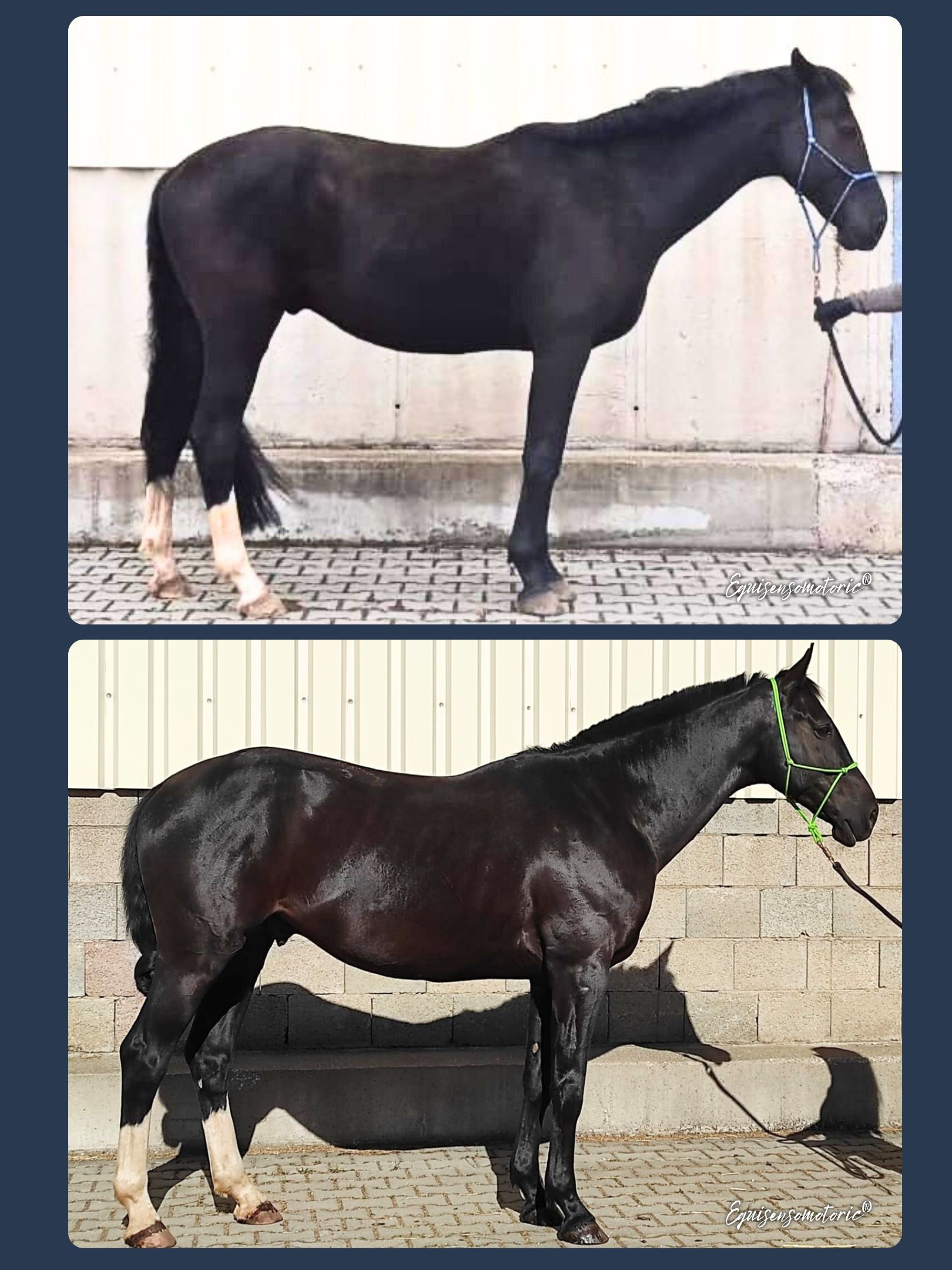
5 months later
While the hypermobile warmblood initially only walked with a wavering, sluggish gait and did not want to trot at all, it soon trotted rhythmically and springily thanks to the measures described here and the development of the trunk lifting muscles.
First aid for a slumped back – here are 10 effective measures and exercises to combat carrying fatigue in horses!
-
Stress reduction & holistic health check: Even if it doesn’t seem like it at first glance, a low held trunk or weak back muscles often stems from a number of other factors that negatively impact your horse’s well-being and muscle development. First and foremost, I would recommend checking your horse’s environment for stressors. Because mental stress tenses and stiffens the horses back, and a stiff back is always held chronically low in between the forelegs! Stressors could include an unpleasant stablemate, insufficient social contact (horses are highly social herd animals that need physical contact with other horses like they need air to breathe), excessive social contact (24-hour open stable in an unsuitable or overly large group), or overly stressful (too ambitious) training by humans.
-
Hoof health: Back and trunk stabilizing muscles, such as the serratus muscles of the thoracic sling, can only develop if your horse can move comfortably (i.e., without pain, navicular syndrome, or pressure from the bars, etc.). Therefore, check or consult with several professionals (there’s nothing like a third or fourth opinion 😉) to determine if the hoof trimming (including the hoof angle and shoeing/gluing intervals) is optimal.
-
Hay quality & mineralization: Optimal feeding and mineralization are essential for hoof growth and muscle development. This doesn’t mean you need to buy lots of expensive “muscle-building” supplements. Less is more, and the best possible hay and a high-quality mineral mix are usually sufficient to support muscle development. In this article, I’ve summarized my feeding recommendations for building trunk and back muscles in horses: Which feeds support muscle development in horses? – My 5 recommendations!
-
Deep sleep: With optimal husbandry, horses sleep lying down for 1-2 hours, with their REM phase lasting approximately 30 minutes. These deep sleep phases are particularly important for mental and physical regeneration. Horses with sleep deprivation (unfortunately common in restless open stable environments) are either excessively skittish and nervous, or lethargic and lacking energy, or unable to concentrate. Deep rest phases are also essential for muscle development. If you are unsure about this, check whether your horse has bedding stuck to its belly and cheek daily (or at least 5-6 days a week), or consider installing a camera in its sleeping area. You want to see your horse lying completely flat and relaxed every day – without any disturbances from other horses.
-
Gastric ulcers: 40-60% of leisure horses have gastric ulcers! In horses that perform under stress in sports, such as racehorses, the figure is as high as 90%! Stomach ulcers develop due to long periods without food (more than 5 hours without hay, which is often the case with stall confinement between 1 a.m. and 6 a.m.) and stress, which may have occurred long ago (e.g., in foals). They cause the horse to have a tense back posture and are very painful. Additionally, inflammation of the small intestine lining can occur, which in turn severely inhibits nutrient absorption (e.g. the nutrients and proteins necessary for muscle development!). Typical signs for ulcers include: horses that are too thin, but also overweight, lack of muscle mass, frequent yawning, bad breath, a crooked back, skittishness, phlegm (i.e., the horse is described as “lazy”), girthiness (i.e., snapping when the girth is tightened), or snapping when the chest muscles are touched. If you suspect stomach ulcers, I strongly recommend having a gastroscopy performed. It’s just a minor procedure performed under sedation while standing, can even be done right there in the stable, and finally provides clarity. Furthermore, the camera allows the extent and location of the gastric ulcers to be determined, enabling your veterinarians to choose the most effective medications. In my experience with clients, I’ve frequently recommended gastroscopy when gastric ulcers were suspected, and a course of medication followed by optimizing the horse’s living conditions and reducing stress has often worked wonders for muscle development and overall well-being.
-
Saddle: I know, it’s a tiresome topic, but I have to say it. If you’re currently riding your horse, the saddle absolutely must fit perfectly and provide 100% even pressure distribution. Any atrophy (e.g. often found behind the shoulder blade in horses with a low held trunk) should be compensated for by the saddle pad. Get creative with your saddle fitter and try different options. Horses love a soft, shock-absorbing pad, such as one made of memory foam. Many simple cotton saddle pads unfortunately offer far too little shock absorption for a horse’s back with atrophied muscles. A treed saddle provides the best pressure distribution over a large area, but before you end up with a tree that doesn’t fit, a treeless saddle with a thick pad is often a good interim solution. Feel free to check out my free saddle course (no registration or email address required!) where I clearly explain all my tips for perfect pressure distribution.
-
Training interval: Okay, and now finally to what you’re probably most interested in. How should you train your horse so that it finally builds back muscles? First of all, let’s talk about intervals. For muscle growth to occur, you or your riding partners should train at least 3 times, ideally 5 times, per week. The training sessions don’t need to be long; 20-25 minutes is often enough if you do the right exercises.
-
Eliminating harmful factors: It might sound strange, but if your horse already has a swayback with a sunken tunk, then—in addition to proper training—you also need to eliminate everything that caused or worsened this condition. This includes:
· Riding and hacking for too long: as a rule of thumb during training, ride for no more than 25 minutes, if at all.
· Too much rider weight: 15-20% of the horse’s own weight is the rule of thumb here, but with a horse that’s under-muscled, it’s better to build muscle from the ground first.
· Too fast: especially in turns (every riding arena, no matter how large, is essentially a “turn” for the horse every few seconds), strong centrifugal forces act on all spinous processes, tendons, and joints of your horse (veterinarian Stefan Stammer has calculated the forces acting on the forehand, for example, to be almost a ton of tensile force!). If you work your horse at too high a speed, i.e., faster than its muscles can withstand, it will tense up instead of building muscle.
· Too much bending of the neck: this causes your horses spine to rotate incorrectly and thus counteracts muscle development and well-being.
· Avoid extreme head and neck positions. Don’t let anyone tell you that your horse’s head should be “set” particularly high or particularly low. Extremes are always unnatural and negatively alter all angles in the horse. An unspectacular head and neck height (neither with excessive elevation nor excessive stretching downwards), which lies somewhere at or slightly above the shoulder joint, is usually a good physiological indicator. However, keep in mind that the head position only indicates what the back is capable of (or not yet capable of). Only an excessively narrow angle between head and neck (ridden behind the vertical due to excessive use of a curb bit or snaffle) should be corrected, as it compresses the parotid gland and causes your horse pain. In this case, ask your horse to open its head and neck angle, so that its nose comes to or slightly in front of the vertical.
· Also, avoid, as Christin Krischke so aptly puts it, “resting in the ligaments” This means don’t sit on a standing horse for unnecessarily long, as you’ll otherwise be sitting in his passive stay apparatus without engagement of his trunk supporting muscles. This puts unnecessary strain on your horse’s nuchal and supraspinous ligaments (which are designed for the horse’s weight, not yours). Therefore, simply dismount as soon as your training session is over or if you need to talk to someone.
-
Optimal Speed and Cadence: If you want to strengthen your horse and build muscle mass, you shouldn’t lunge or ride too fast. The core stabilizing and lifting muscles are part of the deep core musculature. You train these muscles more effectively with subtle shifts in balance at a smooth, slow speed. However, the cadence should be slow enough that the steps are still flowing through, not choppy or jerky which will happen if you go too slow. To begin with, it helps to gradually reduce the horse’s normal pace until you notice a slight swaying, and then use your aids to counteract this swaying. Very similar to exercise balancing on a slackline, your horse will stay more centered every day.
-
Suitable Exercises: Now for the exercises. To build stabilizing core muscles (which your horse lacks not only if it’s hypermobile, but also if it appears “stiff”!), all exercises performed at a slow pace that create a slight (really very slight) bend in girth area are suitable. This straightens your horse and builds muscle strength simultaneously. A “in-the-track” exercise, where the hindquarters follow the forehand, or a shoulder-fore (i.e., a mini-shoulder-in) is often a good starting exercise. The angle of the bend should be kept as small as possible, just enough (or rather, just as little) that you can see or feel some bend in the girth area, but the neck is by no means bent excessively inwards. If your horse overbends its neck, its spinous processes in the thoracic spine will rotate outwards. This causes his back to tense up instead of building back muscles, and exerts one-sided tensile forces on his tendons and joint surfaces. If you are not yet familiar with rotation theory, or if you would like to dive deeper into it, I highly recommend my foundation course and advanced courses. There, I explain the rotation theory, and subsequently the precise aids for it, in great detail and with the help of many illustrative models and videos on visual training in the self-study course.
I hope that these 10 tips and valuable insights from my teaching practice, have provided you with information on which measures and exercises you can take to build up the back muscles and trunk lifting muscles and core stabilizers in your horse!
Enjoy your time with horses and all the best!
Johanna
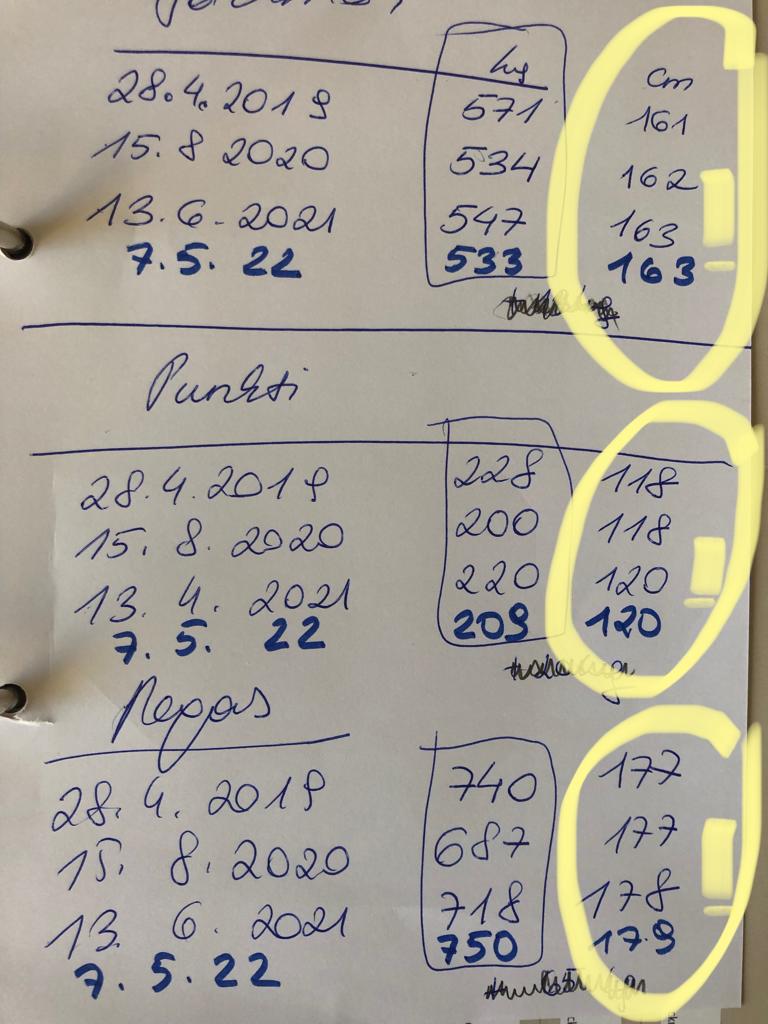
2 cm taller thanks to Equisensomotoric® training
Photo: Dr. Adelheid Kienzl
Training the lift of the trunk
Successful back training reverses carrying fatigue, makes horses strong, keeps them sound and can even be measurable, as customer Dr. Kienzl documented during her annual weight checks. From the 17-year-old Shetland pony to the 22-year-old large horse, all three of her horses had increased in height by 2 cm since starting training at the end of 2019.